
You don’t need to know exactly what your business will become to give people a reason to believe in it. You do need to decide what you’re building toward, and which parts of that conviction can survive a change of plans.
“I don’t want to go public with a message we may have to change tomorrow.”
Fair.
You’re still learning which customers will buy, which features they’ll actually use, and whether the thing everyone loved in the demo is the thing anyone will pay for. You have a budget. You would prefer not to spend it explaining a business that will no longer exist by February.
So you wait. Another product cycle. A few more customer conversations. Maybe three quarters of pipeline, just to be sure.
Meanwhile, your sales team is telling one story. Your website is telling an older one. Your founder has a genuinely exciting version that requires forty minutes and a whiteboard.
You haven’t avoided committing to a narrative. You’ve outsourced it to whoever happens to be talking.
That is the cost of waiting we tend to leave out of the budget discussion.
Direction has never meant knowing everything
Defining where a business is going is hard because it involves choosing among things that could work. Choosing a customer means giving that customer’s needs priority. Choosing a problem means accepting that some adjacent, tempting problems will have to wait.
AI adds another layer of second-guessing. A capability you planned to sell might become something customers expect as standard. A new way to build could change what’s worth building. An opportunity can look enormous before anyone understands how buying it will work.
Under those conditions, keeping every option open can feel like responsible leadership.
But a business with every option open is difficult to run. What should the product team prioritize? Which prospect deserves the extra effort? What should sales stop promising? “We’re exploring a lot of exciting possibilities” does remarkably little work in a Tuesday planning meeting.
Certainty would mean knowing how these decisions will turn out.
Direction means making them anyway, with a reason you can explain and evidence you’re willing to revisit.
You can say, “This is the customer we’re choosing to serve, this is the problem we believe matters, and this is the change we’re working toward,” without claiming to have seen the next five years.
You can also admit what you haven’t figured out. Conviction doesn’t require you to conceal the open questions. It requires you to have an answer to something.
The uncomfortable part comes before the words
Before you tell the story, decide where the business is going.
This sounds obvious until you’re in a room trying to write a positioning statement and discover that three leaders have three different businesses in mind.
One sees an enterprise platform. Another sees a product for small teams. A third wants to keep the language broad enough to accommodate both, plus an opportunity someone mentioned last week.
The resulting sentence will almost certainly contain the word “solutions.”
No amount of writing talent can settle that disagreement. You can make the sentence elegant. You can make it shorter. You cannot make it mean something specific while protecting every competing ambition inside it.
This is the uncomfortable part: sometimes the messaging work exposes a decision the leadership team has been postponing.
Who matters most right now? What are we prepared to deliver? What do we want customers to come to us for? Which attractive possibility are we willing to leave out?
Those are business decisions. The narrative makes them visible.
Once they’re made, the external story has something to stand on. Your priorities become a clear account of whom you help. Your product choices become an explanation of what customers can do differently. Your ambition gives people a sense of where you’re taking them.
Internal clarity becomes external clarity through choices, not adjectives.
And those choices start working well before a buyer understands the product.
Someone arriving at your website, hearing about you from a colleague, or opening a sales email is deciding whether to give you any more attention. They’re trying to place you in their world.
Is this a problem I have? Is this built for someone like me? What would change if it worked? Why should I care now?
A list of capabilities asks the buyer to assemble those answers themselves. A coherent narrative gives them a reason to keep going.
That matters at the very beginning of pipeline. If you’re waiting for enough pipeline to feel confident about the story, consider how much work you’re asking an uncertain story to do in the meantime.
Build something you can move
Still, the objection stands. Messaging costs money. Changing it costs money. Premature positioning can attract the wrong buyers or create expectations the product cannot meet.
The answer is to be deliberate about what you’re committing to.
A useful narrative has a durable center: the people you’re here to serve, the problem you understand, and the improvement you’re working to make possible. Around that center, there should be room for the business to learn.
The feature that best demonstrates your value may change. The use case that gets a buyer’s attention may change. Your proof should get stronger. You may discover that the language customers use is much better than the language you invented in a conference room.
Those changes should have somewhere to go without requiring you to dismantle the entire story.
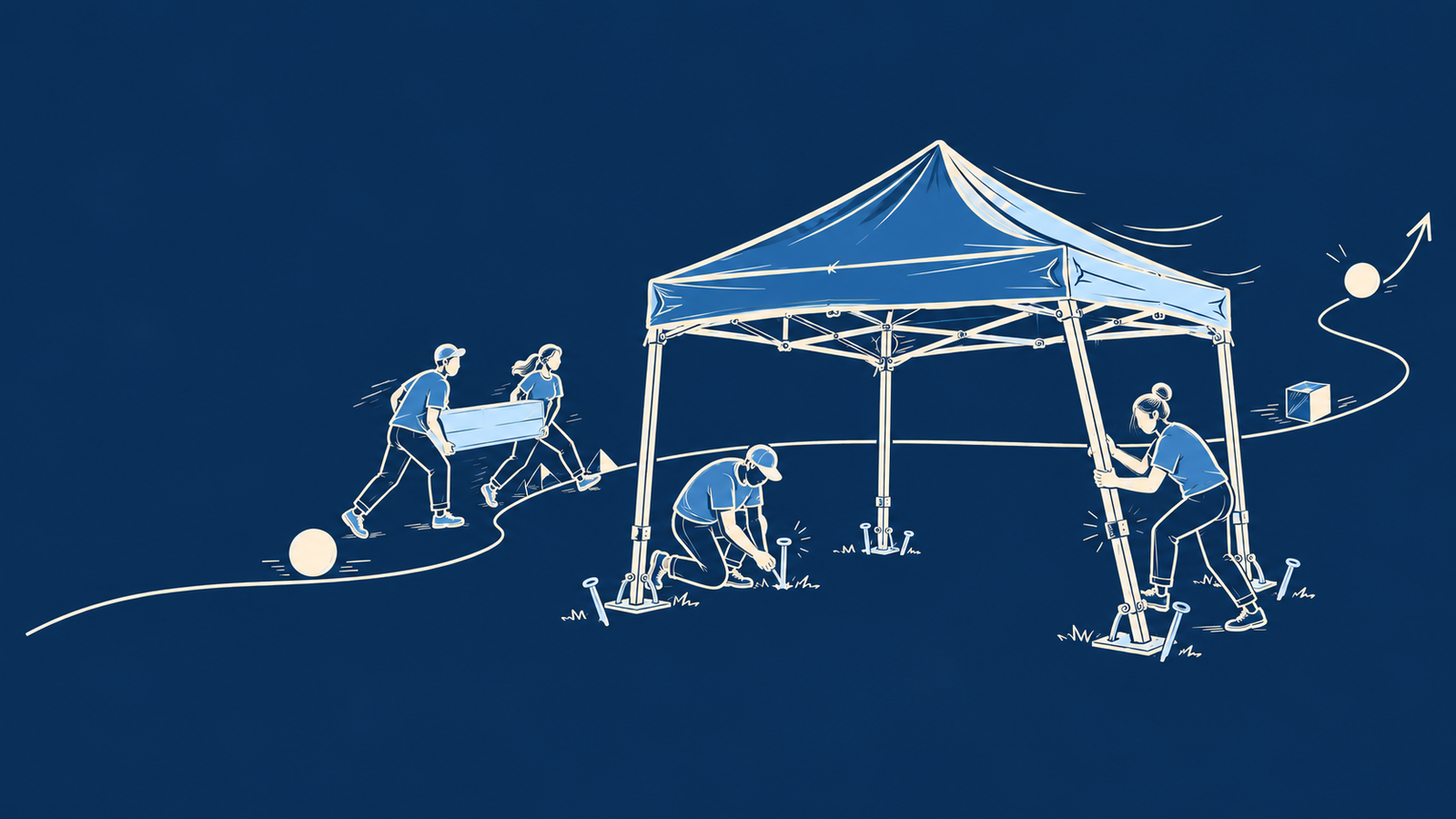
Think pop-up tailgating tent. Slightly less glamorous than the architectural metaphors we usually reach for, but useful. It creates a recognizable place to gather. It has a frame. It needs to be properly anchored. And when the action moves, you can pick it up and put it somewhere else.
The portability is part of the design.
For a business, that means separating what you believe from how you currently express or demonstrate it. It also means distinguishing what the product delivers today from what you intend to make possible. Ambition can give the story energy without being smuggled into a product promise.
None of this makes a narrative permanent. If you discover you’re serving a fundamentally different customer or solving a different problem, the core deserves another look. “Durable” shouldn’t become an excuse to defend a decision the evidence has overtaken.
But revising a clear position teaches you something. You can identify what changed and why. Revising a foggy one mostly produces more fog.
Leaders don’t need to commission a grand pronouncement every time the business learns something. They need a story specific enough to guide decisions now, and a shared understanding of what would cause them to revise it.
The market will keep moving. You will have to make choices before you feel entirely ready.
Your team already has to decide what to build. Your buyers already have to decide whether you matter. They’re making those decisions with whatever story they can find.
Give them one you’re prepared to stand behind, and take responsibility for changing it when the business gives you a reason.